ps <- readRDS("data/moving-pictures-ps.rds")Data structure and prevalence
Microbiome count data is structurally sparse and uneven.
This chapter focuses on:
- Matrix sparsity
- Library size variation
- Taxa prevalence
Load data
Plot theme
This guide uses a consistent CDI plotting theme. It is defined once and reused across lessons.
source("scripts/R/cdi-plot-theme.R")
cdi_teal   <- "#036281"
cdi_yellow <- "#f7c546"
cdi_muted  <- "#475569"
Sparsity
otu <- methods::as(phyloseq::otu_table(ps), "matrix")

if (!phyloseq::taxa_are_rows(ps)) {
  otu <- t(otu)
}

zero_prop <- mean(otu == 0)
zero_prop
[1] 0.9111154Library size variation
lib_size <- phyloseq::sample_sums(ps)

df_lib <- data.frame(
  sample_id = names(lib_size),
  library_size = as.numeric(lib_size),
  stringsAsFactors = FALSE
)

dir.create("outputs/tables", recursive = TRUE, showWarnings = FALSE)
readr::write_csv(df_lib, "outputs/tables/library-size.csv")
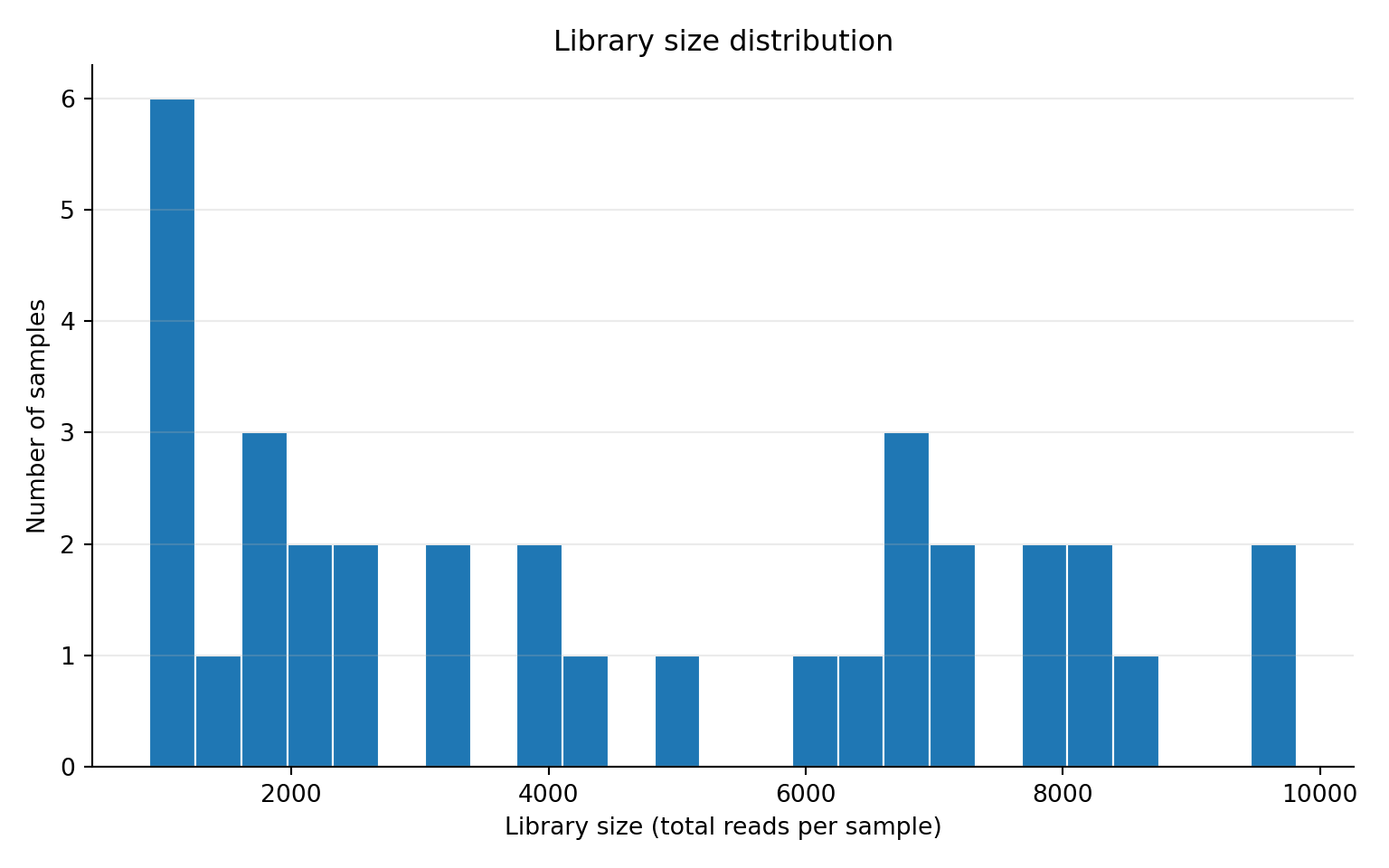
Library size distribution
ggplot2::ggplot(df_lib, ggplot2::aes(x = library_size)) +
  ggplot2::geom_histogram(
    ggplot2::aes(y = ggplot2::after_stat(density)),
    bins = 30,
    fill = cdi_teal,
    color = "white",
    alpha = 0.90
  ) +
  ggplot2::geom_density(color = cdi_yellow, linewidth = 1.2) +
  ggplot2::scale_y_continuous(labels = scales::label_number()) +
  ggplot2::labs(
    title = "Library size distribution",
    subtitle = "Sequencing depth varies across samples",
    x = "Library size (total reads per sample)",
    y = "Density"
  ) +
  cdi_theme() +
  ggplot2::theme(
    plot.subtitle = ggplot2::element_text(color = cdi_muted)
  )
Detection and prevalence
detection <- 1

taxa_prev_n <- rowSums(otu >= detection)

taxa_prev_df <- data.frame(
  taxon = rownames(otu),
  prevalence_n = taxa_prev_n,
  prevalence_frac = taxa_prev_n / ncol(otu),
  stringsAsFactors = FALSE
)

dir.create("outputs/tables", recursive = TRUE, showWarnings = FALSE)
readr::write_csv(taxa_prev_df, "outputs/tables/taxa-prevalence.csv")

summary(taxa_prev_df$prevalence_n)
Min. 1st Qu. Median Mean 3rd Qu. Max.
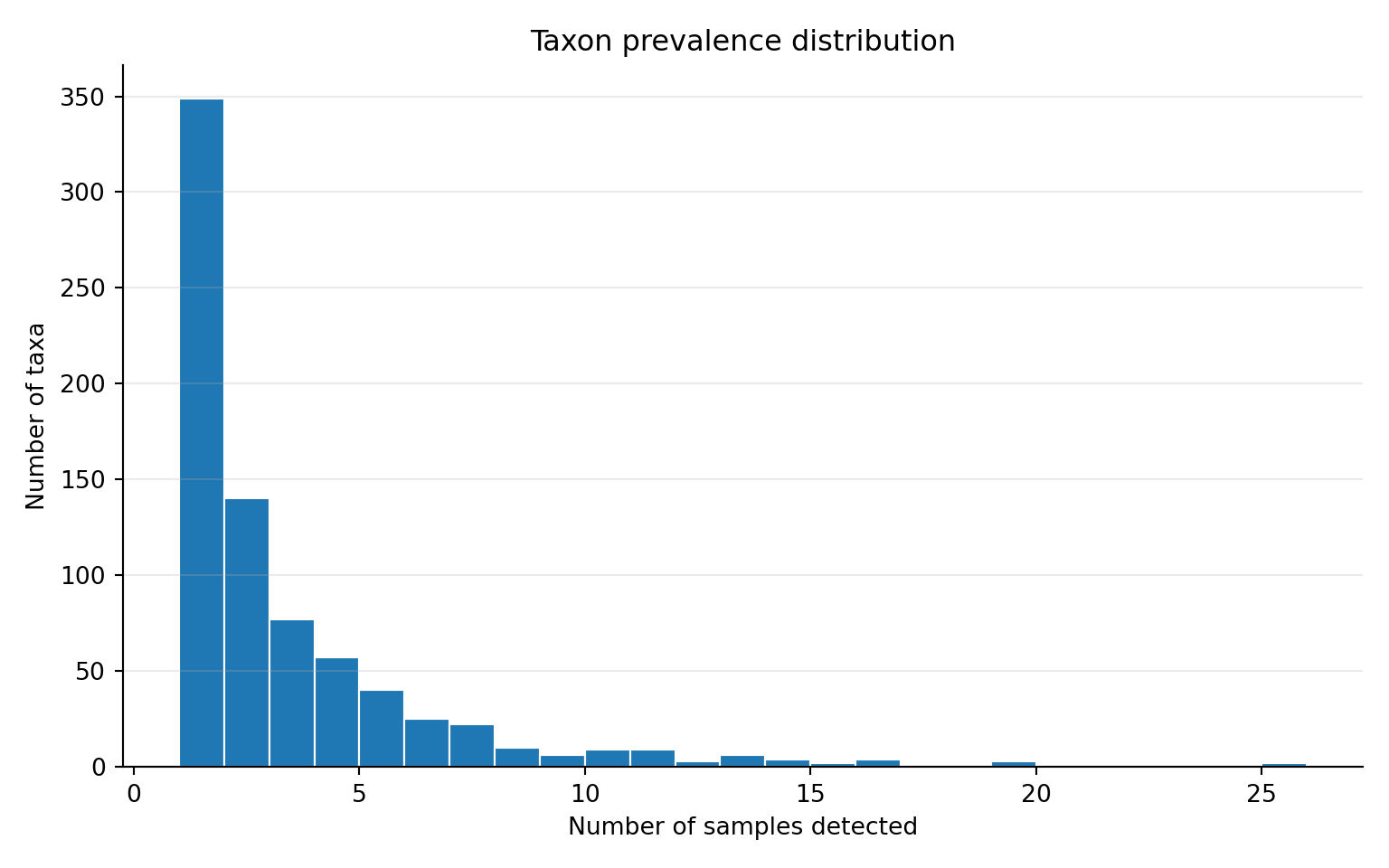
1.000 1.000 2.000 3.022 4.000 26.000 Prevalence distribution
# Histogram view
ggplot2::ggplot(taxa_prev_df, ggplot2::aes(x = prevalence_n)) +
  ggplot2::geom_histogram(
    bins = 30,
    fill = cdi_teal,
    color = "white",
    alpha = 0.90
  ) +
  ggplot2::labs(
    title = "Taxon prevalence distribution",
    subtitle = "Most taxa are detected in few samples",
    x = "Number of samples detected",
    y = "Number of taxa"
  ) +
  cdi_theme() +
  ggplot2::theme(
    plot.subtitle = ggplot2::element_text(color = cdi_muted)
  )
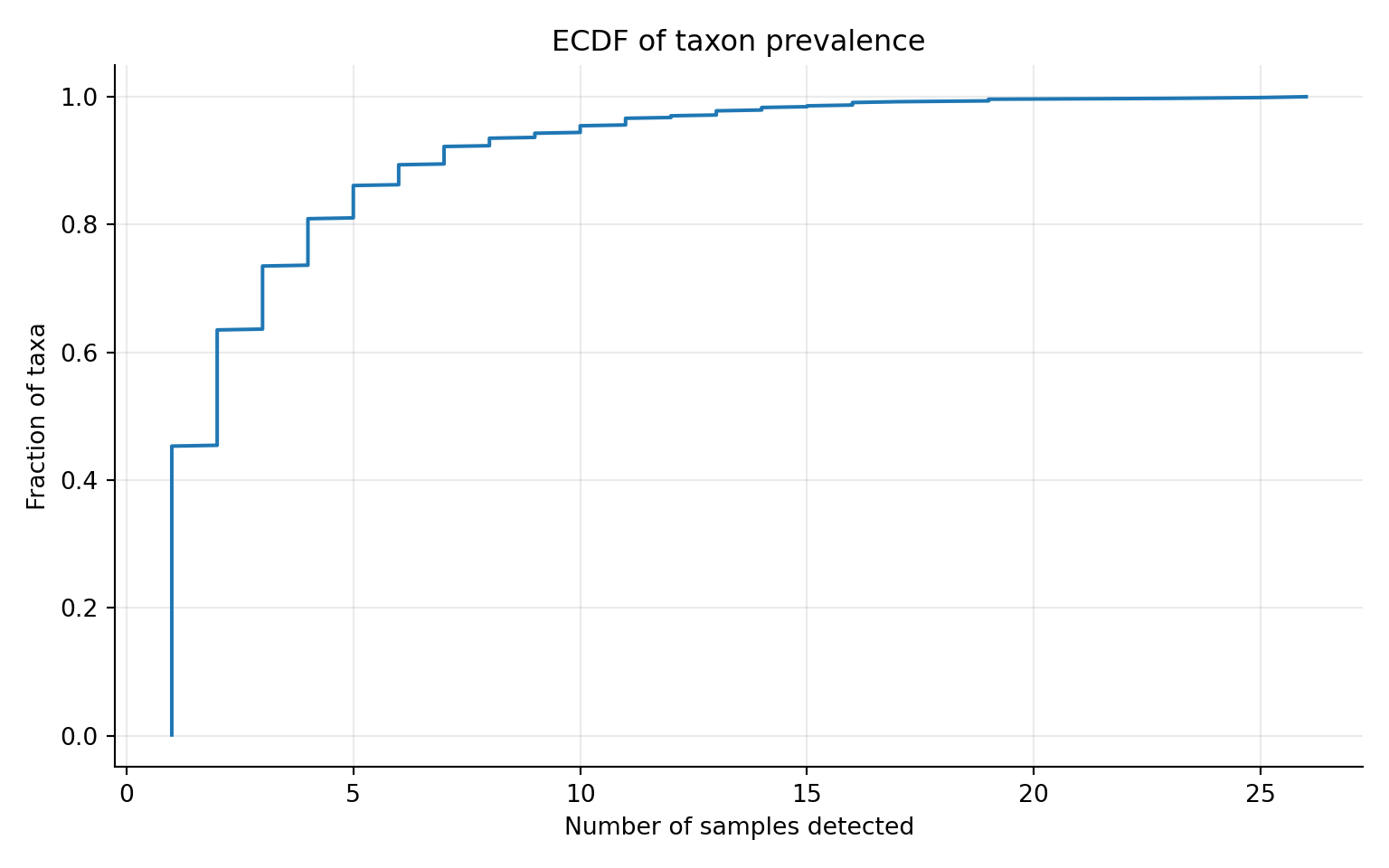
# ECDF view
ggplot2::ggplot(taxa_prev_df, ggplot2::aes(x = prevalence_n)) +
  ggplot2::stat_ecdf(geom = "step", color = cdi_teal, linewidth = 1.2) +
  ggplot2::labs(
    title = "ECDF of taxon prevalence",
    subtitle = "Fraction of taxa detected by at least N samples",
    x = "Number of samples detected",
    y = "Fraction of taxa"
  ) +
  cdi_theme() +
  ggplot2::theme(
    plot.subtitle = ggplot2::element_text(color = cdi_muted)
  )
Simple prevalence filter
min_prev_frac <- 0.10

keep_taxa <- taxa_prev_df$taxon[taxa_prev_df$prevalence_frac >= min_prev_frac]

ps_prev <- phyloseq::prune_taxa(keep_taxa, ps)

c(
  original_taxa = phyloseq::ntaxa(ps),
  after_filter = phyloseq::ntaxa(ps_prev)
)
original_taxa after_filter
770 204 Relative abundance preview
ps_rel <- phyloseq::transform_sample_counts(ps, function(x) x / sum(x))
range(phyloseq::sample_sums(ps_rel))
[1] 1 1